sustainable aerospace manufacturing with additive manufacturing and HIP
highlights
- additive manufacturing reduces waste through near-net-shape aerospace production
- Hot Isostatic Pressing (HIP) ensures material quality by removing porosity and improving mechanical properties
- additive manufacturing + HIP enables lightweight, sustainable aerospace components with reliable performance
.png)
Aerospace manufacturers are under increasing pressure to reduce material waste, lower emissions, and improve production efficiency while still meeting strict safety and performance requirements. Technologies such as Additive Manufacturing (AM) and Hot Isostatic Pressing (HIP) are playing an increasingly important role in addressing these challenges. Traditional manufacturing routes typically rely on machining complex components from oversized billets or forgings, resulting in high material loss, long process chains, and significant energy consumption.
additive manufacturing changes the production logic
Additive Manufacturing (AM) introduces a fundamentally different approach. By building metal components layer by layer directly from digital design data, AM enables near-net-shape production and allows for highly complex geometries that cannot be achieved conventionally. This reduces raw material usage, minimizes machining effort, and opens the door to lightweight design features such as internal channels and lattice structures that improve performance while reducing component mass.
However, despite its advantages, additively manufactured components can contain internal porosity and microstructural variations inherent to the build process. These characteristics can lead to scatter in mechanical properties and limit direct use in safety-critical aerospace applications.
HIP as the enabling step
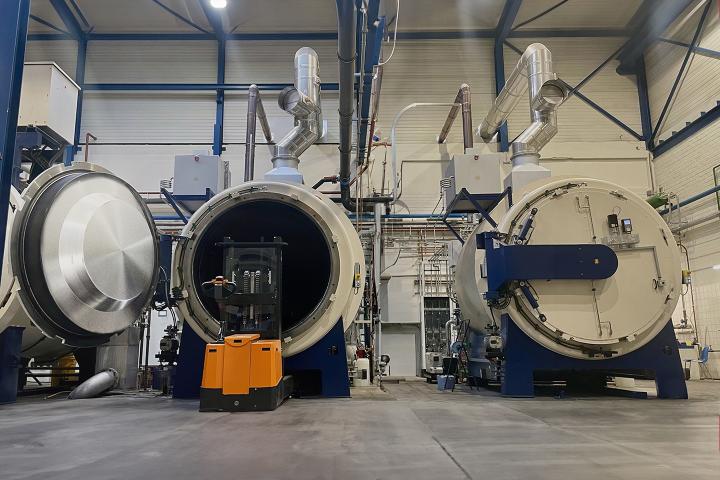
Hot Isostatic Pressing (HIP) addresses this challenge. By applying high temperature and isostatic gas pressure, HIP eliminates internal porosity and homogenizes the microstructure throughout the component. This results in more consistent mechanical properties, improved reliability, and the level of material integrity required for aerospace qualification and serial production.
Beyond structural integrity, aerospace components must also withstand harsh operating environments over long service lives. Here, Aalberts Surface Technologies adds a critical final step. Through advanced surface treatments, components gain enhanced wear resistance, corrosion protection, and improved durability. This ensures that parts not only perform structurally, but also maintain reliability in demanding real-world operating conditions.
The combination of AM and HIP therefore creates a robust and scalable manufacturing route. Material consumption is significantly reduced compared to conventional machining, scrap rates are lowered, and process chains become more efficient. At the same time, component weight reduction contributes directly to improved fuel efficiency and lower operational emissions over the lifetime of an aircraft.
In this way, AM enables the design freedom and material efficiency, while HIP provides the metallurgical reliability needed to bring these components into real aerospace applications. Together, they support a shift toward more sustainable, cost-efficient, and high-performance aerospace manufacturing.
also relevant
other news
most read
latest

.jpg)